|
No. 1 - March 5, 2006 - 'Refreshed' regularly - Editor: John Piek (PA0ETE) |
|
URL: www.pa0ete.com - Dutch Version: www.pa0ete.nl |
|
A television screen of paper and a metal cabinet
Interview with Lody van Dijk |
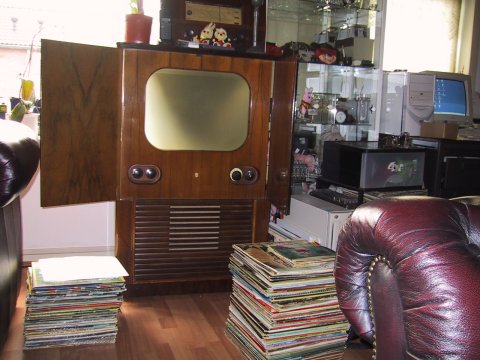
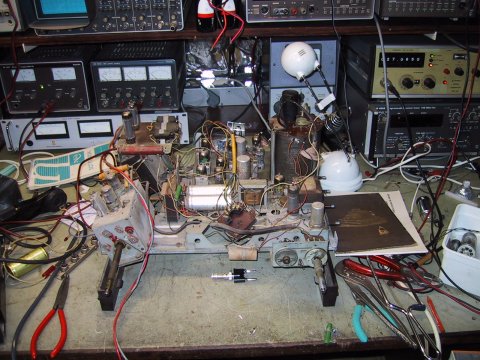
"Repairing old valve equipment is the best!" A television screen of paper and a metal cabinet Next to the things he collects, his hobby consists of repairing old radio's from the era they were all equipped with vacuum tubes. In his house you can also find several Duracell rabbits as seen in a TV commercial. Lody: "I collect many things. Lately I have acquired a special interest in microphones, preferably those from the fifties. In addition to that I collect old phone records, but also video discs. Those rabbits I just collected for a short period. There are many more collectors fond of them. Repairing old valve equipment is what I like most. Meanwhile I have gathered together al the test equipment for this kind of equipment as well, things like tube testers and so on. In my attic II keep a lot of capacitors that are needed repairing these old sets. Tubes are not produced anymore, except for some audio amplifier tubes, so for everything I must lean on old stocks or dismantled equipment. But on the other hand it still amazes me that record players are still being made. And even old style phone records are still being produced as well."
|
Lody has almost all his life been interested in electronics. As a fourteen year old he was always dismantling old radios and rebuilding them again. Most gear these days he gets from people he knows or from neighbors. "Especially when some clears out his attic they often have a lot of interesting stuff for me. And the same is true when someone moves to an old people's home. Most people where I live know of my hobby right now, call me all the time that someone there and there has some interesting material for me. Most of the time I can pick the items up for free, but sometimes I pay a small amount, when the things are in good shape. A number of things I sell again to others, because otherwise I surely would have to move very soon." Lody often buys things on flea markets and sometimes he is present with a market stall himself. "Not that I earn huge amounts with it. Quit on the contrary: more often I get home with more things I took out of the house with me..." He especially recommends the radio market in Bad Bentheim near the Dutch-German border in Germany. And it is very suitable as a family outing as well.
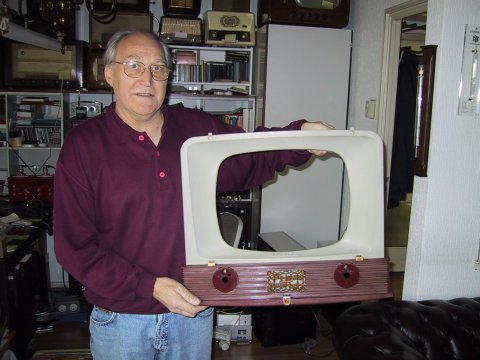
. Metal cabinet One of the most special pieces in Lody's collection is a television set in a metal cabinet of the Philips brand. "Whan I saw the equipment, at first I didn't know what it was. But soon it appeared to be a very special item. Only a few of the type were fabricated. I had it enamelled and now I am looking for a replacement cathode ray tube (MW43-24-R02) because the old one is defective. There might be a replacement that fits, but I'd rather have the original, so maybe there is someone* who knows something more..."
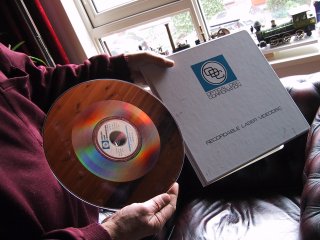
Another special item is a laser disc player. "Did you know in those days there even were writeable laser discs?" Van Dijk shows a two sided writeable laserdisc that is only partly used. "I suppose this one is already made in the seventies. It is funny realizing that it is de predecessor of the current CD and the DVD, but they are as big as an LP album. A great disadvantage compared to a CD is that they are really very vulnerable. Te data is burned on the surface, whilst in CD's it on the other side, behind a thick transparent plastic layer just under the label. As a result of that, modern CD's are much less easily damaged. Another disadvantage here in Europe is that most of the laser discs that are sold here are in the American NTSC TV standard. To be able to play them both the disc player as the TV set must be able to play this standard, which is quit uncommon." |
In spite of the fact that he likes to restore nostalgic radio equipment, he is a rather downright adversary of maintaining the Morse code exams in the Netherlands*. "I simply can't understand that in the 80 meterband or one of the other bands there isn't a bit of space for C-amateurs (technician licenses)*. To me it is nothing more than a hobby, and I want to keep having fun spending time on it. But in my work I used to work with chemicals, and as a result of that it is extremely difficult for me to learn the code. Morse is great fun to the ones that enjoy doing it themselves, but I think it is so outdated that people shouldn't be forced to learn it." A paper tv screen Another very special item is a television
set from the fifties with a revolutionary flat screen made out of paper.
"This set is made in 1952, but the first one was produced in 1951.
In that time cathode ray tubes of this large size couldn't be made. That's
why they made a kind of a beamer, placed in a cabinet Te screen is
projected from a 6 cm (2,2 inch) cathode ray tube onto the transparent paper at the front of the set. I didn't start restoring
this set yet, and I am a bit cautious to do so. A lot of older people warned
me because they read in the papers that the set is quite dangerous,
because it emits a hazardous amount of X-rays. This is most probably
caused by the high voltage that is needed for such a small and powerful CRT."
Lody doesn't fancy computers a lot. He has difficulties working with
them, but still he recently bought a new one. "In spite of my
reservations they are quit handy because of the amount of manuals and
listings with tubes that are available on CD-ROM nowadays" Text and photography: John Piek *This article was originally published in May 2002. Some of the facts in it might be changed or out of date. |
banner of the site (download: right mouse-click, save as...)
©2006, copyright on all material: John Piek,
unless stated otherwise.
Copying, (re-)publishing, on the web, on paper, newsletter or any
other medium is prohibited prior to
written permission of the owner(s).
In addition to national law, the general conditions of Piek-E
press (in Dutch) apply.